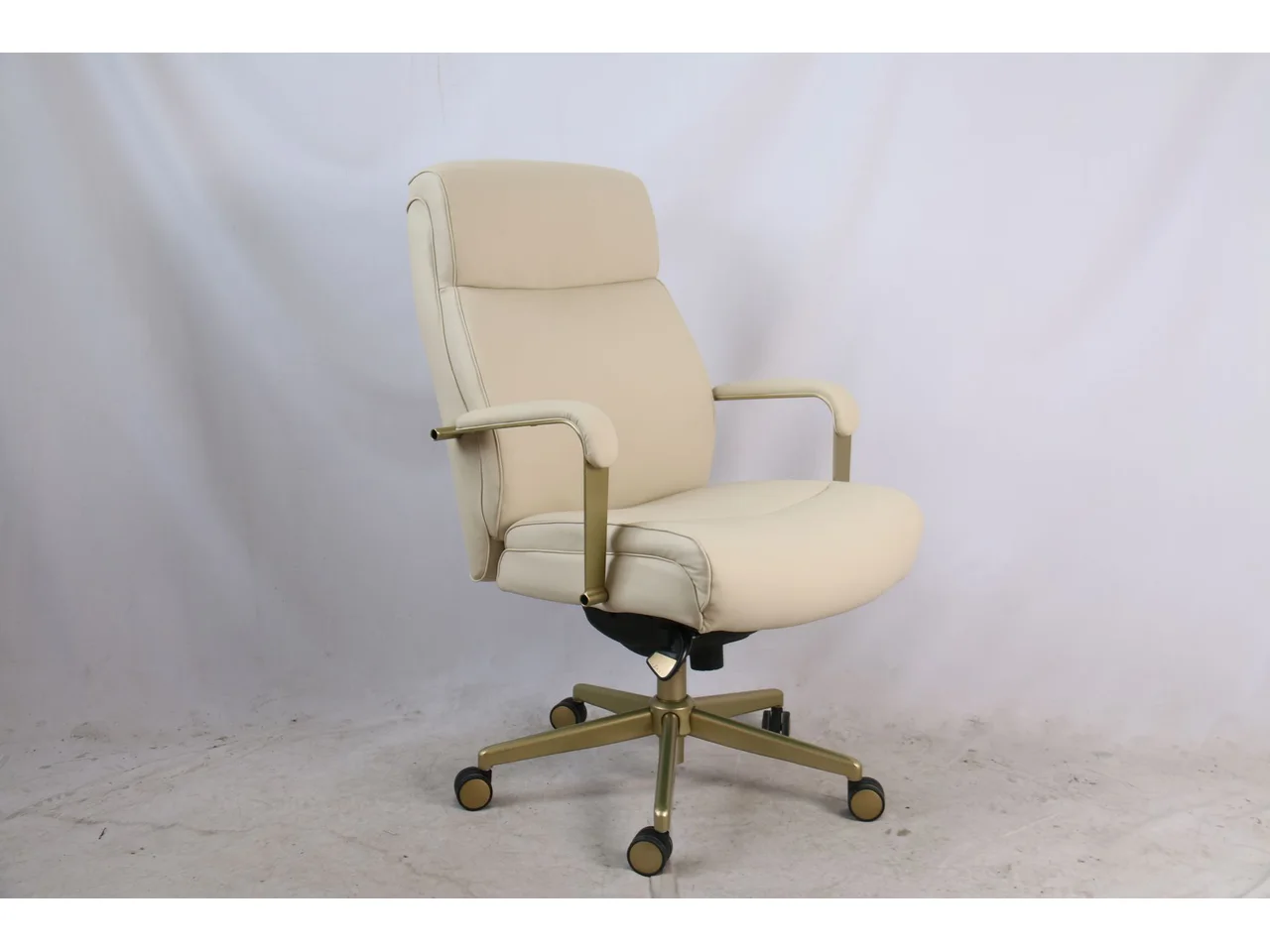
Most of our work is value-tier: chairs that have to land at a price a discounter or a regional retailer can sell, not contract chairs for a head office. So I spend a lot of my week on a question that sounds simple and is not — where do you cut, and where do you absolutely do not. A budget chair done right is a series of deliberate choices. Done wrong, it is a normal chair with random parts swapped to hit a number, and those are the ones that come back.
Where you can cut, on purpose
Foam is the first lever. A medium-density foam around 25–35 kg/m³ is normal in budget seating and gives roughly three to five years of home-level use before it flattens. For a chair that sells at a low price and gets a few hours a day, that is the right call — paying for 50 kg/m³ contract foam buys longevity the end user will never reach, and it adds weight, which adds freight. The second lever is the mechanism. A simple tilt instead of a synchro mechanism saves real money and most home-office buyers never miss it. The third is armrests: fixed arms instead of 3D or 4D adjustable arms cut cost and cut warranty calls, because the moving part you remove is a part that cannot break.
Fabric is the fourth. A mid-weight polyester mesh or a basic woven fabric covers most of the value market and wears fine for the duty. You do not need a 100,000-rub contract fabric on a chair that sees a few hours a day; that is spend the end user cannot see and will not reach.
Castors are the fifth, and they are small money with a big effect. Standard nylon castors are fine on carpet; if your market is mostly hard floors, a PU-coated castor stops the chair from scratching laminate and stops a return that has nothing to do with the chair itself. It costs a little more per set. On a value order we usually offer it as the one upgrade worth taking, because a scratched floor is the kind of complaint that does real reputational damage even when the seat is perfect.
Where cutting comes straight back at you
The base and the gas lift are not where you save. A narrow, under-spec base is the part that tips a user over, and that is not a return — it is a complaint with your brand name on it. We size the base to the user weight regardless of the price tier. The same goes for the cylinder: a chair that slowly sinks is the single most common reason a cheap office chair gets sent back, and a no-name cylinder with no stamp is exactly the part a price-driven supplier swaps quietly. Spend there. We would rather you check the cylinder mark in a photo than take our word for it.
The cardboard matters too, and buyers forget it. On a value order the freight is a big share of the landed cost — a 40-foot container gives you roughly 67 cubic metres of usable space, and a chair that ships flat-packed or nested lets you put hundreds more units in that same box, which lowers the per-chair cost more than any single component swap. We design the carton and the knock-down around the container, not the other way round, because that is where the real money hides on a cheap chair.
The trade-off, stated plainly
Here is the line we hold. We will help you take cost out of a chair until the day the saving starts showing up as a return, and then we stop and tell you so. A supplier who says yes to every downgrade is not doing you a favour; they are letting you ship a problem. The cheapest base, the no-name cylinder and the thinnest carton look great on the quote and terrible on the reorder, because the reorder does not happen. Cut the comfort extras and the adjustments. Keep the structure and the cylinder. That is the whole rule.
A last word on the supplier side of value sourcing: the price you are quoted is only honest if the spec behind it is fixed. Ask any factory — us included — to write the cylinder class, the base diameter, the foam density and the carton spec into the quote, not just a number. A price with no spec is a price that can be hit by quietly downgrading the parts you cannot see, and that is exactly how a cheap chair becomes an expensive return. Pin the spec and the price means something.
We build to ANSI/BIFMA X5.1 and EN 1335 test methods even on the value line, and testing can be arranged per order — a budget price does not mean an untested chair, it means a chair tested to the same methods with cheaper finishes. If you want to see the same model costed at two tiers side by side, send us your target landed price and your market through the contact form, look at our product range, or email [email protected]. Our OEM/ODM team does this costing every week.