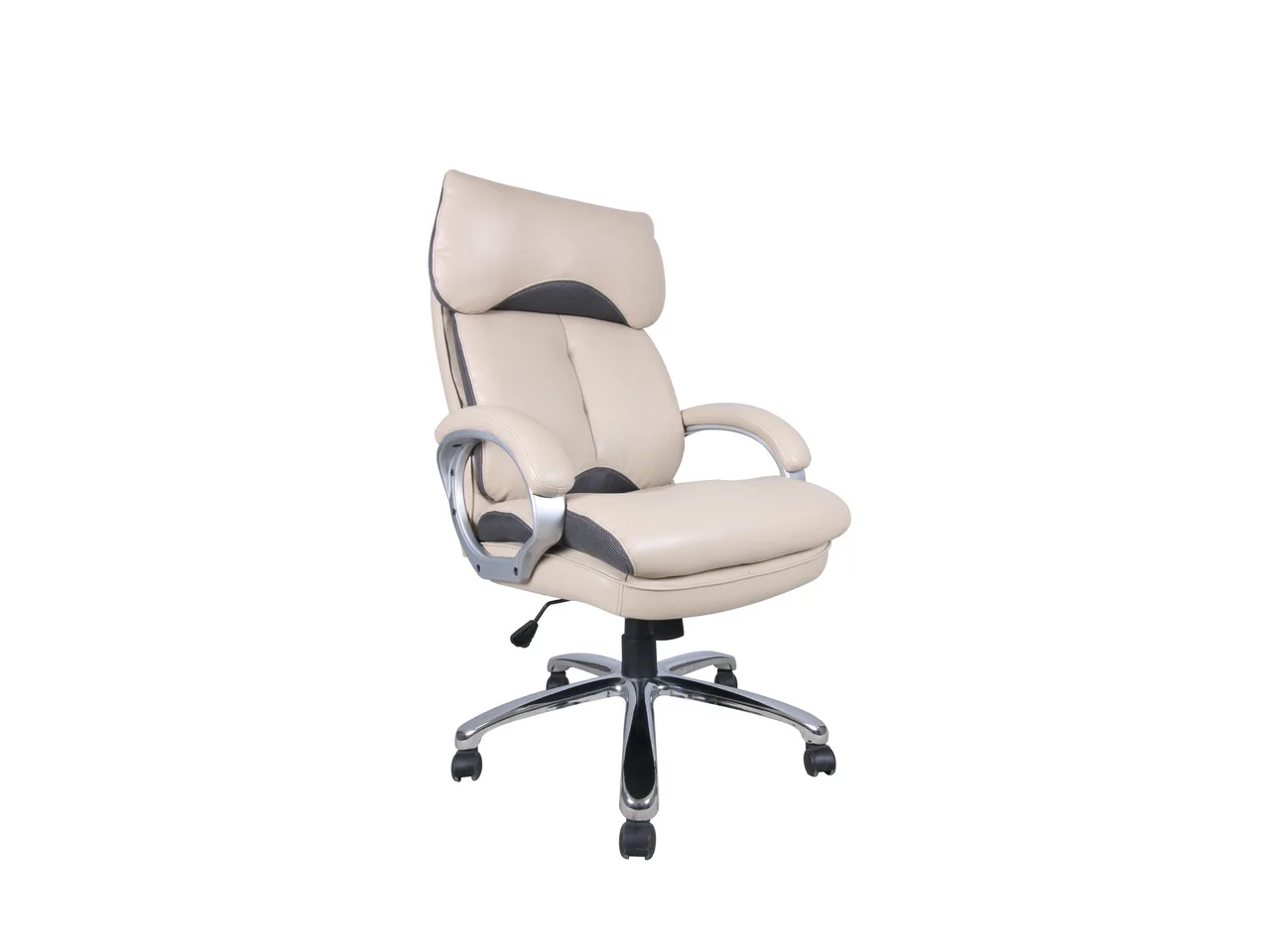
The first thing a new buyer asks after price is "what colours can I get?" — and the honest answer is "as many as your order can carry, which is fewer than you think." Colour and finish are where a budget chair gets its personality, but every extra colour is a separate run of fabric, a separate minimum, and a separate line on your stock sheet. So we plan the palette like a cost exercise, not a mood board.
The two finishes that decide the look
On the soft side you have fabric, PU (the leather-look coated finish) and mesh. Fabric is the cheapest and the warmest-looking, PU wipes clean and reads as upmarket for very little extra, and mesh suits a task chair for a home office where airflow matters. On the hard side — the frame and base — value chairs run on powder-coated steel, which is the durable standard, or on reinforced nylon for an office chair base. Chrome looks premium, costs more, and scratches and pits in a humid climate; we use it where the buyer's market expects it and steer away from it where it just adds cost and warranty risk.
Powder coat is the quiet workhorse here. It is tougher than wet paint, comes in almost any colour, and on a metal-frame dining chair it is what stands between the frame and rust. Black and a grey or white cover the vast majority of sales; the bright colours look great in a catalogue and sell in small numbers.
The MOQ-per-colour math
Here is the part that surprises people. Each fabric colour usually carries its own minimum, because the mill sells fabric by the roll and we cut a run per colour. So a "ten-colour range" on a small total order means tiny quantities per colour, slower production, and stock you cannot move. On a value order we almost always recommend three to four core colours that cover most of the demand — a neutral grey, a black, one warm tone, maybe one accent — and we hold the exotic colours for when the volume justifies them. The same logic applies to powder-coat frame colours: every extra frame colour is another changeover on the line, another setup, and another part number in your warehouse.
Match to a swatch, but plan for the dye lot
If you supply a Pantone or a physical swatch, we can match it closely on fabric and on powder coat — that is normal ODM work. One honest caveat: across separate dye lots and across two different materials (say a fabric seat and a painted frame meant to "match"), there is always a small variance. We plan around it by keeping the matched pair within one production run where it matters, and by being upfront that a fabric grey and a painted grey will read as a deliberate two-tone, not an identical match. Better to design that in than to chase a perfect match that the materials will not hold.
There is a packaging angle to colour, too, that buyers rarely plan for. If you run four colours, your cartons and your shipping marks have to call out the colour clearly, or the warehouse on the far end mixes them and your retail orders ship wrong. We print the colour on the carton and keep one colour per pallet where the order allows, which sounds obvious until you have untangled a container where the colours were stacked at random. A tight palette is easier to pack cleanly as well as cheaper to make — another quiet reason three or four colours beats ten.
The trade-off, stated plainly
It is worth thinking about how you split the quantities, too, not just how many colours. If you run four colours on a 1,000-piece order, an even 250-each split is rarely what the market wants — neutral greys and blacks usually outsell the accent two-to-one. We will help you weight the run toward the colours that move, so you do not end up reordering grey in eight weeks while the bright accent sits on the shelf for a year. A colour plan is a forecast, and a rough forecast beats an even guess.
The trade-off is range versus runnability. A wide palette looks great in a catalogue and ties your money up in slow-moving colours; a tight palette looks plainer and sells through cleanly. We will build whatever range you want, but we will tell you honestly which colours we expect to sit in your warehouse, because we have watched it happen across a lot of orders. Better to launch with four colours that all move and add a fifth once you know your market than to launch with ten and discount six.
If you want help setting a palette to your market and your order size, send us the quantity and the destination through the contact form, look at the finishes across our product range, or write to [email protected]. For a branded line, our OEM/ODM team can match colours to a swatch you supply.