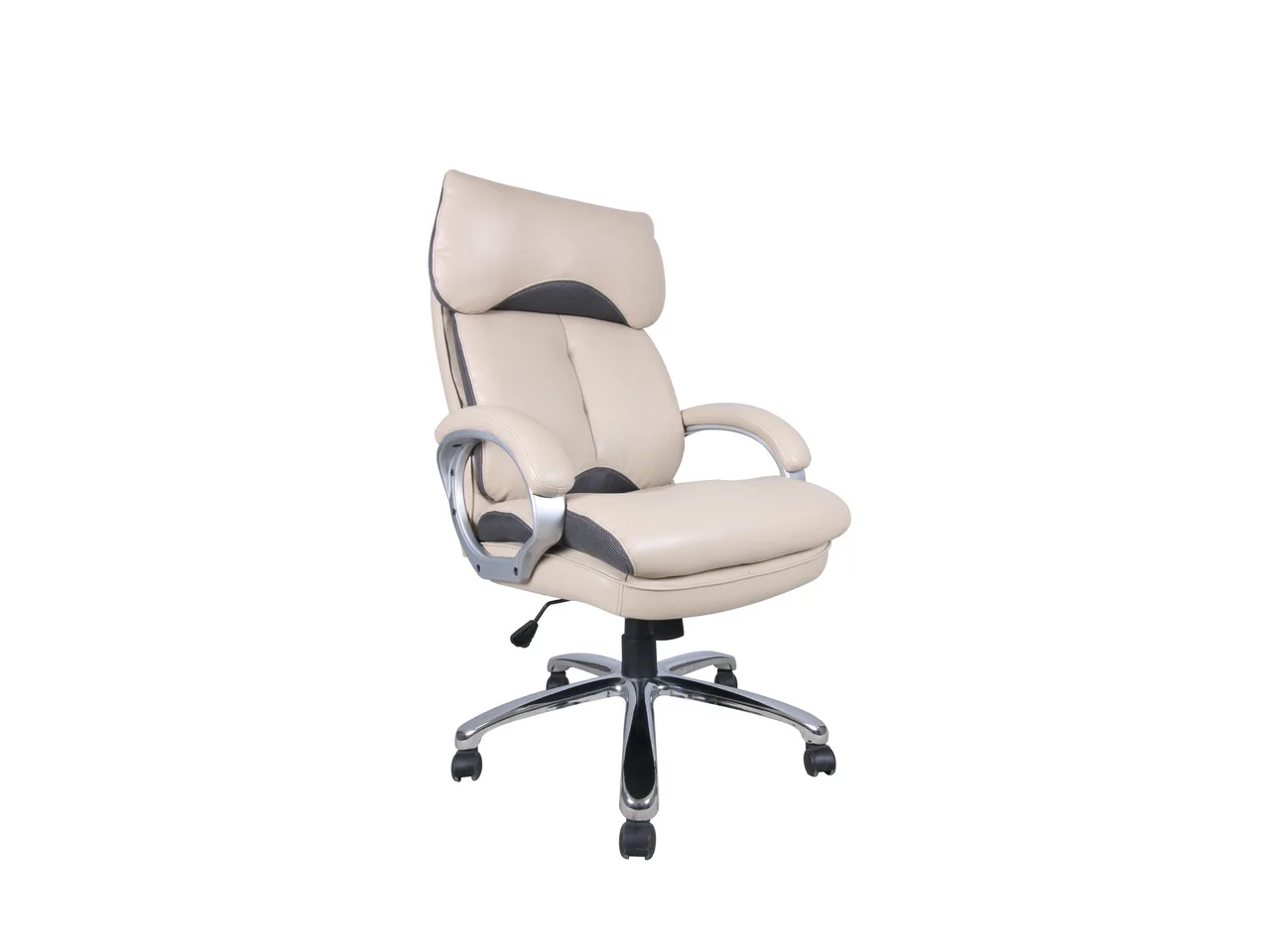
We make both office chairs and dining chairs in the same building, and the question I get most from a new buyer is some version of: "Can't you just use the same frame and put a base under one of them?" No. They share a silhouette and almost nothing else. The day you treat them as the same product is the day a dining chair ends up with a part it does not need and an office chair ends up missing a part it does. So before you put a mixed order together, it helps to know where the two builds actually split.
An office chair is a small machine
Strip the foam off an office chair and you are looking at moving parts. There is a gas lift in the middle, a mechanism above it (a simple tilt, or a synchro that moves the back and seat together), and a five-star base on castors. Each of those is a sourced component with its own load rating and its own failure mode. The base is the part buyers underestimate. A wide reinforced-nylon base — around 700 mm, what the trade calls a 28-inch base — resists tipping better than a narrow aluminium one, even though aluminium sounds like the premium word. We pick the base by the user's weight and how the chair will be used, not by which metal reads better on a spec sheet.
Why five legs and not four? A chair that swivels and rolls has to stay under you while you push off it. Five contact points spread that load so the chair does not tip when you lean to one side. A static chair does not have that problem, which is exactly why a dining chair gets four legs and no one falls over. That single difference — five rolling legs versus four static ones — drives a lot of the cost gap, because the office base is an injection-moulded or cast part with castors pressed into it, and the dining legs are just frame.
A dining chair is a frame and a finish
A dining chair has no gas lift, no mechanism, no castors. The whole job is in the frame joints and the seat. That sounds simpler, and the bill of materials is shorter, but the engineering is not trivial — a dining chair gets sat in, dragged across a floor, leaned back on two legs by a teenager, and stacked. The stress goes into the leg-to-seat joints. So where an office chair eats cost in components, a dining chair eats it in joinery and in the weld or the wood joint that keeps the back from loosening after a year.
This is also why the same fabric costs you differently on the two products. On a dining chair the seat is small and flat, so a metre of fabric covers more chairs and the cutting yield is high. On an office chair you are wrapping a contoured back and a thicker seat, so yield drops and the cut-and-sew time goes up. The padding splits too: a dining seat carries a thin pad over a board, while an office seat carries a moulded foam block. Same word, "upholstered," two different labour bills.
What does carry over between the two
It is not all difference. Fabric colours, the foam grade we run, the carton sizes and the packaging design can all be shared across the two lines, and that genuinely cuts your cost and your stock-keeping. If you buy both an office and a dining line from us in the same season, we will align the colourways so your catalogue looks like one family and your warehouse holds fewer fabric SKUs. The structure does not carry over; the finishes do.
The trade-off, stated plainly
Buyers who want one PO to cover both lines ask us to "standardise." We will standardise the things that genuinely carry over. We will not standardise the structure. The cheapest way to wreck a budget office chair is to put a dining-grade static base under it; the cheapest way to overpay for a dining chair is to spec it like it has to survive eight hours of swivelling. Match the build to the duty and you pay for what the chair actually does, not for a part the user never touches.
We build both to ANSI/BIFMA X5.1 and EN 1335 test methods where the product calls for it, and testing can be arranged through a third-party lab per order — we do not pre-print a certificate that may not match your final configuration. If you are placing a mixed order, tell us the split and the markets and we will quote the two lines separately so you can see where each dollar goes. Our OEM/ODM page explains how we run a combined sample stage, our about page covers what we actually make, or write to us through the contact form or at [email protected].